
Torah 101
First in a series

There are a lot of things I want to write about that touch on Judaism. But most of the people reading what I write lack the background necessary to understand what I’m talking about. So I thought I’d put together a primer to explain some basic things about Judaism.
Note that when I refer to Judaism, I’m referring to the fundamental corpus of law and lore that was given to the Children of Israel (you know us better as Jews) at Mount Sinai by God, and that has been transmitted down through the generations until today. There are various sects that have appeared at different times in history, such as Christianity and Karaites and the Reform Movement (and its derivatives, such as the Conservative Movement), which have abandoned or rejected or distorted the Torah that God gave us. When I speak of Judaism, I’m not talking about those groups.
Note: members of those groups who are Jewish are Jewish. Belonging to a heretical group doesn’t stop a person from being Jewish. Once you’re Jewish, you’re always Jewish. As the Eagles put it, “You can check out any time you like, but you can never leave.”
There are various terms for Jews who have not abandoned the law and lore given to us at Sinai. The one I use most often is “Orthodox Jews”. But there’s a spectrum within that term. There are Haredim (who get called “ultra-Orthodox”, mostly by people who don’t like them), there are Modern Orthodox of various stripes, and so on. But acceptance of the Torah, written and oral, is the sine qua non of being an Orthodox Jew.
Anyway, I’ve used the term Torah several times, but I haven’t defined it. So here we go.
What is the Torah?
The Torah was given to us at Mount Sinai. It consisted of a written component and an oral component, and the whole thing was given directly by God to Moses during the 40 years we spent in the desert.
Contrary to the belief of non-Orthodox Jews and of non-Jews, the Oral Torah is not “commentary” on the Written Torah. It is not subordinate to the Written Torah. It would not be inaccurate to say that the converse is true. The Oral Torah is the primary corpus of law and lore in Judaism.
How do I mean this? Let’s take, for example, the famous “eye for an eye” passages in the Torah. According to the Oral Torah, we don’t actually take out a person’s eye if they cause someone else to lose an eye. The different terms “eye for an eye, tooth for a tooth, burn for a burn”, etc., are essentially a mnemonic (an asmachta in the jargon of Torah) to remember the five different categories of compensation in torts: Nezek (loss of the individual’s value), boshet (embarrassment), tzaar (pain and suffering), ripui (medical expenses), and shabat (loss of work).
I’ve seen many books, written by non-religious Jews or non-Jews, claiming that the original meaning of “an eye for an eye” was literal lex talionis (law of retaliation). And that the rabbis moderated what the Torah said by converting it to monetary compensation. This is not true. The law was always monetary compensation. The phrasing in the Written Torah was a mnemonic for the actual law. Among other things. (Another basic understanding of Judaism is that there’s no “one reason” for anything that God does. So being a mnemonic isn’t necessarily the only purpose of that phrasing.)
Continuity
Surely you aren’t suggesting that the religion practiced by Jews today is the same religion practiced during biblical times?
No, of course I’m not suggesting that. I’m stating it outright. Because it is. Would it look the same to an outside observer? I’m sure it wouldn’t. But that’s because an outside observer wouldn’t understand how the Torah works.
(And… don’t take this the wrong way, but if it looks that way to you, then you are an outside observer.)
The specific practice of Jews at any given time and place is called halacha. The word simply means the way we go. What we do in practice. But that’s not all halacha is. It’s also a system by which we determine what we do in practice. And that system is part and parcel of the Torah God gave us.
I have a little bit of math in my background. Not a lot, but enough that I think of this in mathematical terms:
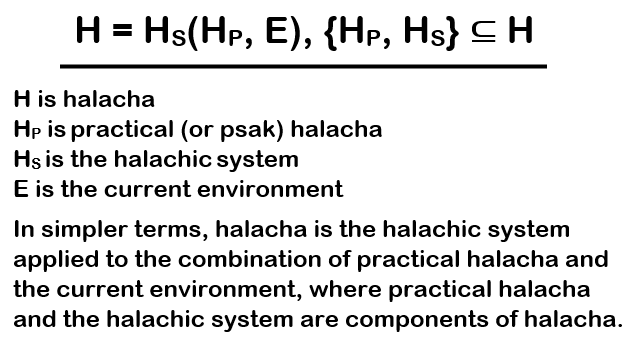
It’s a recursive system. It allows the system to adapt and thrive, but it’s heavily constrained. If we have the rules of practice wrong, or have analyzed our current environment incorrectly, the result won’t be right. If we operate on the rules of practice and our current environment with a system other than the halachic system, the result won’t be right.
For example, part of our current environment is our inability (not unwillingness) to bring sacrifices on the Temple Mount. Something, incidentally, that does not require the Temple to be built. Building the Temple is an obligation, and bringing the sacrifices is an obligation. The one is not dependent on the other. But our requirement to bring those sacrifices has specific conditions, and one of them is our ability to access the site freely. Lacking that ability, we simply aren’t required to bring the sacrifices. This doesn’t mean that the law requiring us to bring them has gone away. It remains the law, and the moment we are able to bring them, we’ll have to do so. And we will do so.
To an outside observer, of course, it looks like we simply don’t bring them any more because… reasons. Maybe because it would squick people out. Maybe because Judaism has “evolved”. But that’s not true, and those who think it is simply misunderstand what Judaism is and how it works.
The same is true of the various cases of death penalties described in the Torah. They are all still in force. But they have conditions that make them impossible at the moment. We haven’t gotten rid of the law; we simply have to take the conditions into account. When the current environment changes, the law becomes practicable again.
So yes, Jews sacrificing bulls and sheep and goats and doves and grain at the Temple in Jerusalem in the Iron Age and Jews using timers to have electrical appliances go on and off automatically on Shabbat in the 21st century… that is the same religion.
Riddles and Data Compression
But isn’t the Talmud the Oral Law? Are you saying that the Talmud was given at Sinai as well?
No and no. Clearly the Talmud isn’t the Oral Law. It’s written down. Does it contain Oral Law? Yes, of course it does. It’s a record of discussions about the Oral Law, and it’s the application of the formula I described above. But that formula means that everything in the Talmud was included, in potential, in the Oral Torah that was given to us at Sinai.
All of biblical and rabbinic literature is predicated on understanding it as a collection of riddles. Among other things (see what I said above about layered usage).
To most people in the Western world, a riddle is a dumb joke. Dixie Cups once did a series of what they called Dixie Riddle Cups, back in the 1970s. One of the dumb ones that stuck in my head was, “What do you get when you cross an elephant and a jar of peanut butter?” The answer? “An elephant that sticks to the roof of your mouth.” A meaningless joke posing as a riddle.
Some people are familiar with riddles that use more brain power. “Poor people have it. Rich people need it. If you eat it you die. What is it?” The answer is “nothing”. But while this kind of riddle can sharpen your thinking, it doesn’t really convey a lot of meaning.
Let’s consider a Jewish riddle that most people don’t even think of as a riddle. We recite it at the Passover seder every year.
This is the bread of affliction that our ancestors ate in the land of Egypt.
All who are hungry, come and eat.
All who are in need, come and partake of the paschal sacrifice.
This year, we are slaves. Next year, we will be free men.
This year, we are here. Next year, we will be in the Land of Israel.
This is a riddle, because you have to think hard about what’s being implied.
We eat matza on Passover because it’s the bread we ate as we left Egypt. It is, in fact, the bread of redemption. So why call it the bread of affliction?
We do open our door later in the seder, but we don’t now. So who are we telling to come and eat?
You can’t eat the paschal sacrifice unless you’re already full. It’s the last thing you eat at the seder. But we’re saying this at the very beginning of our seder. And we don’t bring the paschal sacrifice nowadays, because we don’t have access to the Temple Mount, so why are we inviting people to eat a non-existent sacrifice?
Are we slaves? Really? I’ve heard a ton of cute ideas, like we’re slaves to money, or we’re slaves to social expectations, but that’s a metaphor. We’re not actually slaves.
And how many people who recite this every year have any intention whatsoever of being in Israel the following year? Not many.
So what’s going on here? The answer (an answer, if you like) is that we’re speaking from the point of view of a Jew in Egypt at the very first Passover. The night before we left Egypt. Matza was not yet the bread of redemption. It was only the slave bread we and our ancestors had been eating in Egypt. We are telling those who have not yet eaten their fill to do so, because otherwise, they won’t be able to partake of the paschal sacrifice, and we’re telling those who have already eaten their fill and now need to eat the paschal sacrifice to do so. We were slaves. And had we not sinned in the desert, the following year, we absolutely would have been in the Land of Israel.
The Passover Haggadah says later on, “A person must see himself as though he himself had gone out of Egypt.” That’s what our passage is about. It's a kind of meditation, intended to get us into the mindset that when we’re sitting down at the table, we aren’t in the 21st century, celebrating a holiday. We’re in 1311 BCE, in Egypt, scared and excited and full of the knowledge that tomorrow, the whole world will change.
That’s a riddle. A teaching riddle. And it’s the key to how the Torah functions.
Every word, every letter, everything means something. We don’t use language casually. If the Torah says in one place that Noah brought two of each animal onto the ark and in another place it says he brought 7 of each tahor animal, it’s our job to understand how both of those are true. Using language this way allows us to pack a tremendous amount of information into a relatively small amount of text.
Coming Up…
That’s enough for now, I think. If you have questions about this, I’d be happy to expand on them or clarify things. Seriously, feel free to hit up the comments (which are always open). I try to always answer comments.
Here are a few of the topics I’m hoping to address shortly. As I do, I’ll come back here and put in links. If I think of other topics within the rubric of Torah 101, I’ll add them here as well. Feel free to suggest your own. I don’t guarantee to do them, but I’m open to suggestions.
What Were Prophets For?
Why Don’t Jews Currently Have a Central Authority?
What Does God Want from Non-Jews?
See you shortly,
Lisa
Great post! Looking forward to the next one.
About this:
"The same is true of the various cases of death penalties described in the Torah. They are all still in force. But they have conditions that make them impossible at the moment. We haven’t gotten rid of the law; we simply have to take the conditions into account. When the current environment changes, the law becomes practicable again."
My favorite analogy to describe this is that Halachic Judaism functions like a chess board.
Each piece has its immutable rules about how they move around the board. Those rules don't change. But sometimes history takes certain pieces OFF THE BOARD.
You look at prophets, Sanhedrin, kings, Kohen Gadol etc. as some of the more exotic chess pieces like the Queen, knights and bishops who can move in really unique, powerful ways. But at this point in history, we are in exile and queens, knights and bishpos are off the board. We only have rooks, pawns and the King (The Torah itself, so to speak--without which, the "game" would be over).
Since the rules which govern each piece are immutable, we can't turn pawns into bishops in order to be able to bring korbonos. We can't turn rooks into queens to give capital punishments. etc.
"There are various sects that have appeared at different times in history, such as Christianity and Karaites and the Reform Movement (and its derivatives, such as the Conservative Movement), which have abandoned or rejected or distorted the Torah that God gave us."
Rabbi David Bar Hayim has mentioned these groups, and included the Tzadoqim (Sadducees) before them. He suggested that all wanted to battle against the Torah, but knew that taking the great power which is Torah head on would never work. And so, they decided to attempt to chip away at it a bit at a time, beginning with the authority of the Oral Law.